The biggest mistake students make when thinking about UNC is assuming it a safety or target for Ivy League hopefuls. This is far from the truth “ especially for out-of-state students.
UNC is one of the country's premier public universities, which means it carries two responsibilities that occasionally pull it in different directions. It needs to compete academically with some of the nation's strongest universities while also primarily serving the state that funds and supports it. That balancing act influences everything from enrollment policies to admissions decisions.
Students sometimes approach UNC expecting a slightly less selective version of Duke, Vanderbilt, or Georgetown. It its own thing! UNC has a strong culture of public service, student involvement, school pride, and community engagement. Like the schools they™re compared to, of course, academic excellence matters here. But UNC is also trying to build a campus filled with students who will contribute to the university, participate in its traditions, engage with their communities, and take advantage of the opportunities available to them. So, how do they do it?
Who Actually Gets Into UNC?
Most admissions conversations begin with grades and test scores. At UNC, the more interesting place to start is geography, even though grades and scores are right behind it.
State law limits the percentage of students who can come from outside North Carolina. That means in-state and out-of-state applicants are often navigating very different systems. A student applying from Charlotte or Raleigh is competing within a system designed to prioritize North Carolina residents. A student applying from California, Texas, New York, or Florida is competing for a much smaller number of available seats. You can see this in the in- and out-of-state applicant stats:
| First-time, first-year applicants | In-state | Out-of-state | International |
|---|---|---|---|
| Applied | 16,553 | 42,085 | 7,897 |
| Percent of total applicant pool | 24.90% | 63.30% | 11.90% |
| Admitted | 6,289 | 2,792 | 1,128 |
| Acceptance Rate | 37.90% | 6.60% | 14% |
| Enrolled | 3,859 | 507 | 274 |
| Yield Rate | 61.40% | 18.20% | 24.30% |
| Percent of incoming class | 83.20% | 10.10% | 5.90% |
Part of the reason UNC's admissions statistics can feel confusing is that these two applicant pools are often discussed together, even though the application experience can look very different. Their testing range may look wider than Duke on the surface, but we™re willing to bet the out-of-state admits are almost identical in academic strength to those of more selective schools.
Academically, admitted students are exceptionally strong. Successful applicants generally earn excellent grades while taking demanding coursework throughout high school. Honors classes, AP courses, IB programs, dual enrollment, and advanced academic opportunities all help demonstrate your ability to handle college.
Testing can strengthen an application, too, and we always recommend it for our out-of-state students. Competitive applicants often submit SAT and ACT scores that place them near the top of the applicant pool; the same goes for GPA. However, the challenge is that academic strength is now common among applicants, and you need more than perfect stats to stand out.
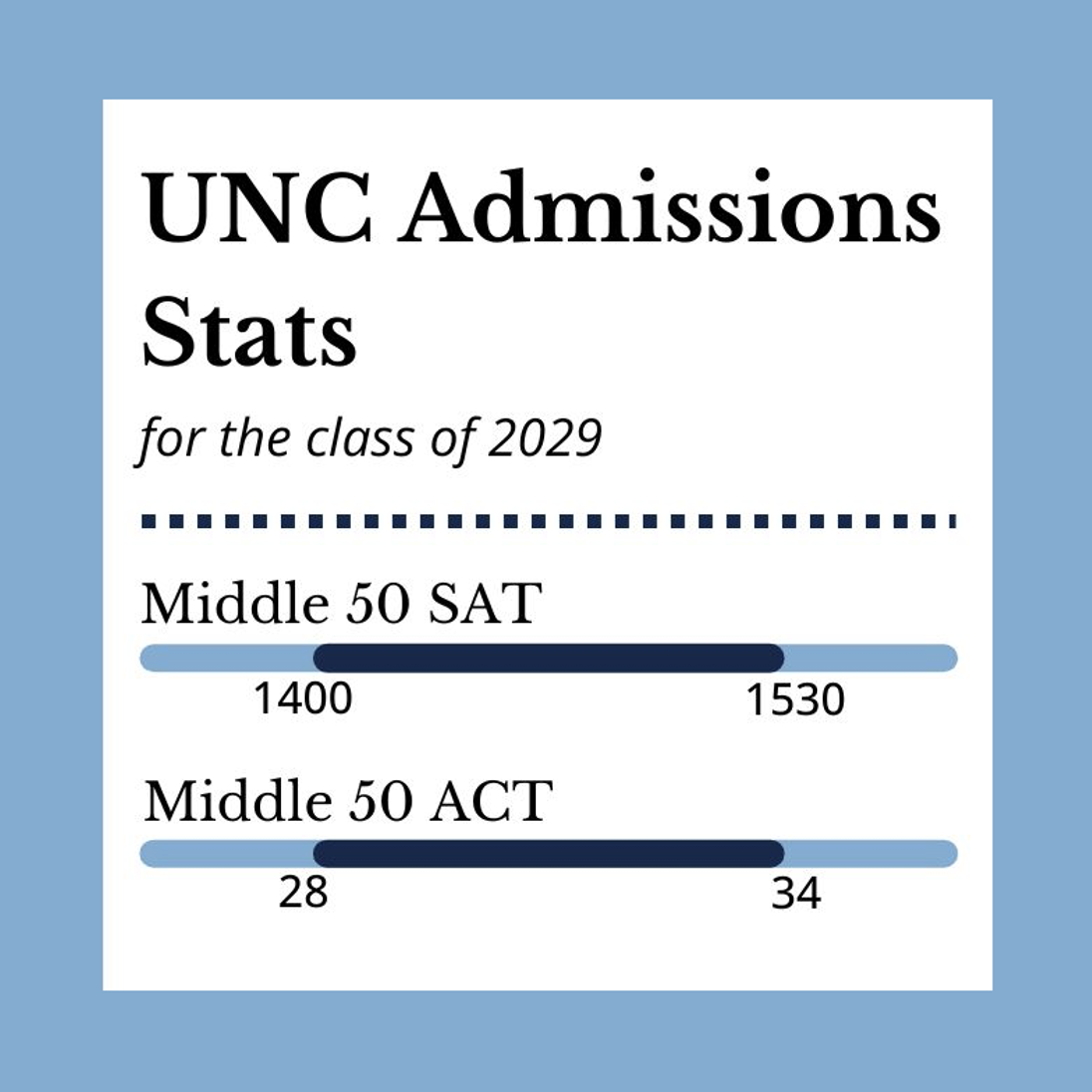
First-time, first-year students with scores in each range:
| Test | 25th Percentile | 50th Percentile | 75th Percentile |
|---|---|---|---|
| SAT Composite | 1,400 | 1,470 | 1,530 |
| SAT Evidence-Based Reading + Writing | 690 | 730 | 750 |
| SAT Math | 700 | 750 | 780 |
| ACT Composite | 28 | 31 | 34 |
| ACT Math | 26 | 29 | 33 |
| ACT English | 27 | 33 | 35 |
| ACT Science | 26 | 30 | 34 |
| ACT Reading | 30 | 33 | 35 |
| GPA Range | Percentage |
|---|---|
| 4 | 97.00% |
| 3.75 - 3.99 | 2.00% |
| 3.5 - 3.74 | 1.00% |
Toooons of students apply with transcripts that suggest they can thrive academically, but admissions officers are not spending most of their time trying to determine whether applicants can succeed in college. They want to learn how students might contribute once they get there.
Strong applicants to UNC join, or better yet, start organizations. They take on leadership roles that make sense, not just because it looks good. They participate in service initiatives, publications, research projects, student government, cultural organizations, athletics, and community programs. And that what separates all the 4.0s and 1550+s from each other.
What Does UNC Really Want to See?
UNC culture has really emphasized involvement, leadership, collaboration, and service. Students who flourish at Carolina frequently become deeply connected to organizations, causes, and communities that matter to them. They are often the people who volunteer to organize events, lead initiatives, mentor younger students, improve existing programs, or help institutions function more effectively. While this is often not a huge concern for other elite schools, being engaged in service opportunities in HS can really help you stand out at UNC.
You also want to develop a strong, clear academic interest. The strongest applicants demonstrate genuine engagement with subjects they care about, and their resumes reflect that. Their activities sections and essays contain evidence that students pursued interests beyond the classroom, explored questions independently, and developed expertise over time. But those interests also should exist alongside meaningful contributions to schools, teams, organizations, and communities.
You do not necessarily need to present yourself as a future world-changing visionary. That not really UNC vibe. That intensity can be saved for UChicago and Stanford, and if that how you present and feel about yourself, UNC might not be the place for you! Of course, they enroll ambitious students, but they also want students who understand how to work with other people, contribute, and, honestly, can hang.
How Does UNC Decide Who Gets in?
UNC claims their admissions are holistic. Our least favorite buzzword. Sure, it holistic, but only if you already meet the academic benchmarks. Semi-holistic or whatever.
A better way to think about the process is that UNC is trying to assemble a class capable of serving multiple purposes at once. The university needs future researchers, physicians, teachers, journalists, business leaders, public servants, and engineers to fill out a full class. They also need students from different parts of North Carolina, different regions of the country, different socioeconomic backgrounds, and different life experiences.
The admissions office is not ranking applicants from strongest to weakest, and they™re paying close attention to how students have used the opportunities available to them. In reading applications, admissions officers often try to understand whether students have demonstrated initiative, engagement, resilience, leadership, or intellectual curiosity within their particular environment.
As we™ve said before, perfect grades in the hardest classes possible are mandatory, but admissions decisions also usually involve a broader set of considerations that transcripts alone can capture:
| Nonacademic Factors | Very Important | Important | Considered | Not Considered |
|---|---|---|---|---|
| Interview | X | |||
| Extracurricular activities | X | |||
| Talent/ability | X | |||
| Character/personal qualities | X | |||
| First generation | X | |||
| Alumni/ae relation | X | |||
| Geographical residence | X | |||
| State residency | X | |||
| Religious affiliation/commitment | X | |||
| Volunteer work | X | |||
| Work experience | X | |||
| Level of applicant interest | X |
The only things they don care about are your interview, geographical residence (i.e., having a fair balance of students from all states), your religious affiliation, and your level of interest. Everything else is on the table.
How Can I Get into UNC?
Students who put together compelling UNC applications usually have a clear understanding of what they actually want from the university. They know why they're interested in Chapel Hill instead of one of the dozens of other excellent public universities around the country “ or even one of the other University of North Carolina schools! They understand the academic opportunities, programs, research centers, professional pathways, or campus experiences that make UNC particularly attractive to them, and they can articulate them in their applications.
Students can pursue undergraduate research through the Office for Undergraduate Research, become involved with public policy through the Carolina Center for Public Service, work with faculty, participate in global programs, contribute to student publications, and take advantage of resources that many students don't fully discover until after they've enrolled. And all of these things (and more!) can, and should, be mentioned in the essays.
Applications are strongest when students demonstrate they have done more than glance at rankings and acceptance rates. The admissions office spends all day reading applications from students who claim they want a great education, but with no substance to back it up. What tends to be more interesting is evidence that a student understands how they might actually use the opportunities available to them.
Academic preparation remains extremely important for our out-of-state hopefuls, but you can have that and a bland resume and hope to stand out. Students who do stand out often have a sense of direction, interests they want to explore, skills they want to develop, communities they want to engage in, etc., etc. Making sure that communicated clearly through your application is crucial.
How Can TKG Help?
A lot of families indulge in the increasingly performative ritual of college admissions they see touted online. Students feel pressure to optimize every decision, pursue every opportunity, and build applications that look impressive from a distance. In the process, they often lose sight of two simple questions: what do I actually want to do, and where is the best place to do it at?
UNC is a large, dynamic school with tons of opportunities. Because of this, students can have dramatically different experiences depending on how they engage with the university, what college they™re targeting, what programs they™re considering, and more. Understanding that fit, and what your goals are early on in the process often leads to better, more strategic decisions throughout high school.
At The ¶¶ÒõÊÓƵ, we spend a great deal of time helping students identify where their interests are leading them and how different colleges align with those interests. Beyond optimizing for their number-one school, we might refine their college list, help them pursue opportunities that deepen an existing academic interest, or point them toward an academic field they might not have considered. We also help strategize testing, pick classes for high school, plan for summer, and handle anything else that comes up before applications open. We also guide students through the practical realities of admissions: essays, supplements, interviews, and application strategy.
Most students don't need more activities, they need better strategy. Helping families make those decisions earlier and more intentionally is what we do best.
Conclusion
UNC combines the resources, opportunities, and academic strength of a major flagship institution with a campus culture that remains unusually connected to its traditions, community, and public mission. That vibe attracts a wide range of students, and the competitiveness of admissions reflects that.
UNC is not searching for a single type of student, they™re assembling a class that will take advantage of what the university offers in different ways and then contribute back to the institution in return. That means your application needs to reflect the values UNC cares about, and students who understand that tend to have better results.
Need help getting into a Top 20 school? Reach out to us today.